
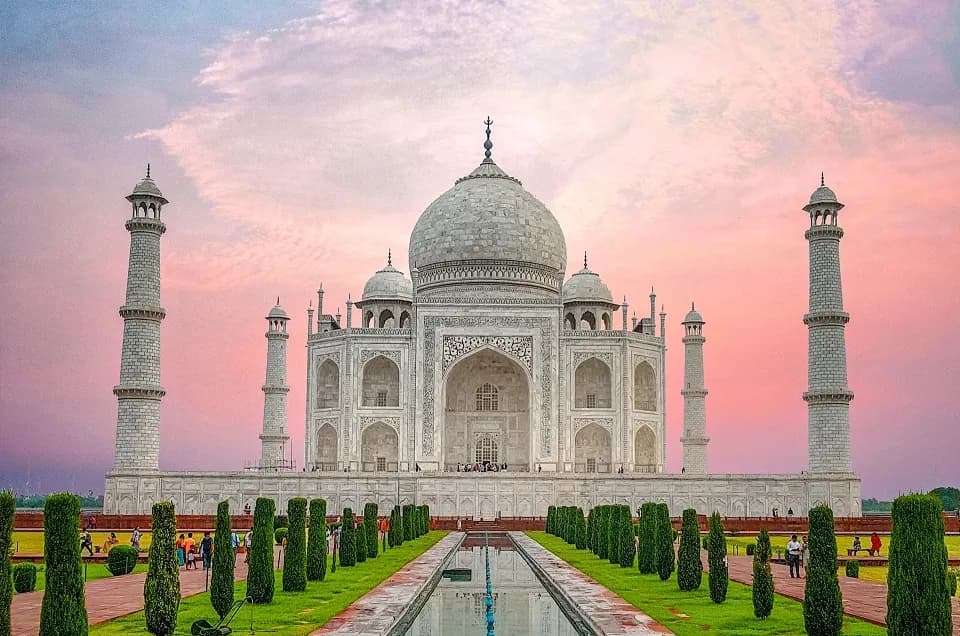
About Taj Mahal
The Taj Mahal is the reason most travellers come to Agra, and it lives up to every photograph. Built by the Mughal emperor Shah Jahan in memory of his wife Mumtaz Mahal, this ivory-white marble mausoleum sits on the south bank of the Yamuna River, framed by a formal garden, a red sandstone mosque, and a matching guest house.
Up close, the details are just as remarkable as the silhouette. Verses from the Quran in black marble frame the arches, and flowers of semi-precious stone are inlaid into the marble using a technique called pietra dura. The marble also changes with the light: soft pink at sunrise, dazzling white at noon, and golden in the late afternoon.
Plan to spend two to three hours walking through the Great Gate, along the gardens and reflecting pool, into the mausoleum, and out onto the riverside terrace. Arriving at opening time rewards you with cooler air, softer light, and far fewer people.
History & significance
Mumtaz Mahal died in 1631 while giving birth to her fourteenth child. The grieving emperor commissioned a tomb unlike any before it, and work began in 1632. The main mausoleum was finished around 1643, and the wider complex around 1653, with an estimated 20,000 artisans, masons, and calligraphers drawn from across the empire and beyond.
When Shah Jahan died in 1666 he was buried beside his wife. The Taj Mahal was declared a UNESCO World Heritage Site in 1983 and is widely regarded as the finest example of Mughal architecture, blending Persian, Islamic, and Indian design traditions.
Highlights
- The main mausoleum with the cenotaphs of Mumtaz Mahal and Shah Jahan
- Pietra dura inlay of flowers in semi-precious stones
- The red sandstone Great Gate (Darwaza-i-Rauza)
- Charbagh gardens and the long reflecting pool
- The mosque and its mirror-image guest house on either side
- Riverside terrace with views across the Yamuna to Mehtab Bagh
Things to do at Taj Mahal
- 01
Watch sunrise through the Great Gate
Enter at opening time and pause inside the Great Gate. The first view of the mausoleum, framed by the arch, is the moment most visitors remember.
- 02
Walk the gardens and reflecting pool
Stroll the raised walkways of the charbagh. The marble bench midway along the pool is the classic spot for a reflection photo.
- 03
Step inside the mausoleum
Buy the mausoleum add-on to enter the octagonal chamber with the cenotaphs and the carved marble screen. Shoe covers are provided.
- 04
Look closely at the inlay and calligraphy
Stand near the main arches to see the stone flowers and the Quranic verses. The lettering is sized so it looks even from the ground.
- 05
Visit the Taj Museum
On the western side of the garden, the small museum has Mughal paintings, original drawings, and objects from the period. Entry is included.
- 06
See it by moonlight
Night viewing runs on full moon nights and two nights either side, except Fridays and during Ramadan. Tickets are limited and sold in advance by the ASI.
Did you know?
- The four minarets lean very slightly outward, so that in an earthquake they would fall away from the tomb.
- The real graves of Mumtaz Mahal and Shah Jahan lie in a quieter crypt below the cenotaphs you see in the main hall.
- Shah Jahan's cenotaph, added after his death, is the only element in the whole complex that breaks the perfect symmetry.
- The calligraphy around the main arch grows larger towards the top, which makes it appear the same size from the ground.
- The marble appears to change colour through the day, from pink at dawn to white at noon and gold at sunset.
Getting there by Agra Metro
Get off at Taj Mahal metro station, about 1 km (a 13 minute walk) from the complex. Polluting vehicles are not allowed near the monument, so the final stretch is on foot, by electric bus, or by golf cart.
Facilities
- Cloakroom / lockers
- Restrooms
- Drinking water
- Licensed guides
- Battery cars
- Wheelchair access
- Photography allowed (not inside the mausoleum)
Visitor tips
- 1Book e-tickets online in advance to skip the ticket counter queue, and carry a photo ID.
- 2Food, tobacco, tripods, drones, and large bags are not allowed. Use the cloakroom near the gates.
- 3Petrol and diesel vehicles cannot go near the monument. The last stretch is on foot, by battery bus, or by golf cart.
- 4The East Gate usually has shorter queues than the West Gate.
- 5Hire only licensed guides who carry an official ID card.
- 6Wear comfortable shoes and carry water. There is little shade on the garden walkways.
Taj Mahal: frequently asked questions
Why is the Taj Mahal closed on Fridays?
The mosque inside the complex is still in use, so on Fridays the Taj Mahal is open only to people attending the afternoon prayers. It is closed to sightseeing for the whole day.
Can you go inside the Taj Mahal?
Yes. With the ₹200 mausoleum add-on you can enter the main chamber and see the cenotaphs of Mumtaz Mahal and Shah Jahan. Photography is not allowed inside.
Can I buy Taj Mahal tickets online?
Yes. E-tickets can be booked on the official ASI booking website. Booking online saves time at the ticket counter, especially on weekends.
Can you visit the Taj Mahal at night?
Night viewing is allowed on the full moon night and the two nights before and after, except on Fridays and during Ramadan. Tickets are limited and must be bought a day in advance.
What items are not allowed inside the Taj Mahal?
Food, tobacco, lighters, tripods, drones, and large bags are not allowed. Small bags, water bottles, mobile phones, and cameras are permitted.
Which metro station is nearest to Taj Mahal?
The nearest Agra Metro station to Taj Mahal is Taj Mahal Metro Station (1 km, about 13 min walk). Agra Fort Metro Station is another option nearby.
What are the timings of Taj Mahal?
Taj Mahal is open 30 minutes before sunrise to 30 minutes before sunset. It is closed on Fridays (open only for afternoon prayers at the mosque). Timings can change on holidays, so check locally before you go.
What is the entry fee for Taj Mahal?
Entry to Taj Mahal: ₹50 for Indian citizens, ₹540 for SAARC and BIMSTEC nationals, ₹1,100 for foreign visitors. Mausoleum entry is ₹200 extra. Children under 15 enter free. Fees are set by the Archaeological Survey of India and can change..
What is the best time to visit Taj Mahal?
October to March, when mornings are cool and clear. Arrive at sunrise for the softest light and the smallest crowds.
How much time do I need at Taj Mahal?
Plan for about 2 to 3 hours at Taj Mahal.
